We hope this content will help those who are just about to start their webmaster adventure or have so far not paid too much attention to search engine-friendly design. Over time as you gain experience you may want to have a look at our more advanced Google SEO Starter Guide. As always we welcome all webmasters and site owners, new and experienced to join discussions on our Google Webmaster Help Forum.
Kamis, 14 Maret 2013
We created a first steps cheat sheet for friends & family
We hope this content will help those who are just about to start their webmaster adventure or have so far not paid too much attention to search engine-friendly design. Over time as you gain experience you may want to have a look at our more advanced Google SEO Starter Guide. As always we welcome all webmasters and site owners, new and experienced to join discussions on our Google Webmaster Help Forum.
Selasa, 12 Maret 2013
New first stop for hacked site recovery
We certainly hope you never have to use our new Help for hacked sites informational series. It's a dozen articles and over an hour of videos dedicated to helping webmasters in the unfortunate event that their site is compromised.
Overview: How and why sites are hacked
If you have further interest in why cybercriminals hack sites for spammy purposes, see Tiffany Oberoi’s explanation in Step 5: Assess the damage (hacked with spam).
Tiffany Oberoi, a Webspam engineer, shares more information about sites hacked with spam
And if you’re curious about malware, Lucas Ballard from our Safe Browsing team, explains more about the topic in Step 5: Assess the damage (hacked with malware).
Lucas Ballard, a Safe Browsing engineer, and I pretend to have a totally natural conversation about malware
While we attempt to outline the necessary steps in recovery, each task remains fairly difficult for site owners unless they have advanced knowledge of system administrator commands and experience with source code. For helping fellow webmasters through the difficult recovery time, we'd like to thank the steady members in Webmaster Forum. Specifically, in the subforum Malware and hacked sites, we'd be remiss not to mention the amazing contributions of Redleg and Denis Sinegubko.
How to avoid ever needing Help for hacked sites
Just as you focus on making a site that's good for users and search-engine friendly, keeping your site secure -- for you and your visitors -- is also paramount. When site owners fail to keep their site secure, hackers may exploit the vulnerability. If a hacker exploits a vulnerability, then you might need Help for hacked sites. So, to potentially avoid this scenario:
- Be vigilant about keeping software updated
- Understand the security practices of all applications, plugins, third-party software, etc., before you install them on your server. A security vulnerability in one software application can affect the safety of your entire site
- Remove unnecessary or unused software
- Enforce creation of strong passwords
- Keep all devices used to log in to your servers secure (updated operating system and browser)
- Make regular, automated backups of your site
Written by Maile Ohye, Developer Programs Tech Lead
Jumat, 22 Februari 2013
A reminder about selling links that pass PageRank
Google has said for years that selling links that pass PageRank violates our quality guidelines. We continue to reiterate that guidance periodically to help remind site owners and webmasters of that policy.
Please be wary if someone approaches you and wants to pay you for links or "advertorial" pages on your site that pass PageRank. Selling links (or entire advertorial pages with embedded links) that pass PageRank violates our quality guidelines, and Google does take action on such violations. The consequences for a linkselling site start with losing trust in Google's search results, as well as reduction of the site's visible PageRank in the Google Toolbar. The consequences can also include lower rankings for that site in Google's search results.
If you receive a warning for selling links that pass PageRank in Google's Webmaster Tools, you'll see a notification message to look for "possibly artificial or unnatural links on your site pointing to other sites that could be intended to manipulate PageRank." That's an indication that your site has lost trust in Google's index.
To address the issue, make sure that any paid links on your site don't pass PageRank. You can remove any paid links or advertorial pages, or make sure that any paid hyperlinks have the rel="nofollow" attribute. After ensuring that no paid links on your site pass PageRank, you can submit a reconsideration request and if you had a manual webspam action on your site, someone at Google will review the request. After the request has been reviewed, you'll get a notification back about whether the reconsideration request was granted or not.
We do take this issue very seriously, so we recommend you avoid selling (and buying) links that pass PageRank in order to prevent loss of trust, lower PageRank in the Google Toolbar, lower rankings, or in an extreme case, removal from Google's search results.
Posted by Matt Cutts, Distinguished Engineer
Rabu, 20 Februari 2013
Make the most of Search Queries in Webmaster Tools
If you’re intrigued by the Search Queries feature in Webmaster Tools but aren’t sure how to make it actionable, we have a video that we hope will help!
Maile shares her approach to Search Queries in Webmaster Tools
This video explains the vocabulary of Search Queries, such as:
- Impressions
- Average position (only the top-ranking URL for the user’s query is factored in our calculation)
- Click
- CTR
- Prepare by understanding your website’s goals and your target audience (then using Search Queries “filters” to support your knowledge)
- Sort by clicks in Top queries to understand the top queries bringing searchers to your site (for the given time period)
- Sort by CTR to notice any missed opportunities
- Categorize queries into logical buckets that simplify tracking your progress and staying in touch with users’ needs
- Sort Top pages by clicks to find the URLs on your site most visited by searchers (for the given time period)
- Sort Top pages by impressions to find valuable pages that can be used to help feature your related, high-quality, but lower-ranking pages
Written by Maile Ohye, Developer Programs Tech Lead
Rabu, 23 Januari 2013
A faster image search
People looking for images on Google often want to browse through many images, looking both at the images and their metadata (detailed information about the images). Based on feedback from both users and webmasters, we redesigned Google Images to provide a better search experience. In the next few days, you’ll see image results displayed in an inline panel so it’s faster, more beautiful, and more reliable. You will be able to quickly flip through a set of images by using the keyboard. If you want to go back to browsing other search results, just scroll down and pick up right where you left off.
Here’s what it means for webmasters:
- We now display detailed information about the image (the metadata) right underneath the image in the search results, instead of redirecting users to a separate landing page.
- We’re featuring some key information much more prominently next to the image: the title of the page hosting the image, the domain name it comes from, and the image size.
- The domain name is now clickable, and we also added a new button to visit the page the image is hosted on. This means that there are now four clickable targets to the source page instead of just two. In our tests, we’ve seen a net increase in the average click-through rate to the hosting website.
- The source page will no longer load up in an iframe in the background of the image detail view. This speeds up the experience for users, reduces the load on the source website’s servers, and improves the accuracy of webmaster metrics such as pageviews. As usual, image search query data is available in Top Search Queries in Webmaster Tools.
Posted by Hongyi Li, Associate Product Manager
Senin, 17 Desember 2012
Webmaster Tools verification strategies
Verifying ownership of your website is the first step towards using Google Webmaster Tools. To help you keep verification simple & reduce its maintenance to a minimum, especially when you have multiple people using Webmaster Tools, we’ve put together a small list of tips & tricks that we’d like to share with you:
- The method that you choose for verification is up to you, and may depend on your CMS & hosting providers. If you want to be sure that changes on your side don’t result in an accidental loss of the verification status, you may even want to consider using two methods in parallel.
- Back in 2009, we updated the format of the verification meta tag and file. If you’re still using the old format, we recommend moving to the newer version. The newer meta tag is called “google-site-verification, and the newer file format contains just one line with the file name. While we’re currently supporting ye olde format, using the newer one ensures that you’re good to go in the future.
- When removing users’ access in Webmaster Tools, remember to remove any active associated verification tokens (file, meta tag, etc.). Leaving them on your server means that these users would be able to gain access again at any time. You can view the site owners list in Webmaster Tools under Configuration / Users.
- If multiple people need to access the site, we recommend using the “add users” functionality in Webmaster Tools. This makes it easier for you to maintain the access control list without having to modify files or settings on your servers.
- Also, if multiple people from your organization need to use Webmaster Tools, it can be a good policy to only allow users with email addresses from your domain. By doing that, you can verify at a glance that only users from your company have access. Additionally, when employees leave, access to Webmaster Tools is automatically taken care of when that account is disabled.
- Consider using “restricted” (read-only) access where possible. Settings generally don’t need to be changed on a daily basis, and when they do need to be changed, it can be easier to document them if they have to go through a central account.
We hope these tips help you to simplify the situation around verification of your website in Webmaster Tools. For more questions about verification, feel free to drop by our Webmaster Help Forums.
Posted by John Mueller, Webmaster Trends Analyst, Zurich
Senin, 12 November 2012
Giving Tablet Users the Full-Sized Web
Since we announced Google’s recommendations for building smartphone-optimized websites, a common question we’ve heard from webmasters is how to best treat tablet devices. This is a similar question Android app developers face, and for that the Building Quality Tablet Apps guide is a great starting point.
Although we do not have specific recommendations for building search engine friendly tablet-optimized websites, there are some tips for building websites that serve smartphone and tablet users well.
When considering your site’s visitors using tablets, it’s important to think about both the devices and what users expect. Compared to smartphones, tablets have larger touch screens and are typically used on Wi-Fi connections. Tablets offer a browsing experience that can be as rich as any desktop or laptop machine, in a more mobile, lightweight, and generally more convenient package. This means that, unless you offer tablet-optimized content, users expect to see your desktop site rather than your site’s smartphone site.
Our recommendation for smartphone-optimized sites is to use responsive web design, which means you have one site to serve all devices. If your website uses responsive web design as recommended, be sure to test your website on a variety of tablets to make sure it serves them well too. Remember, just like for smartphones, there are a variety of device sizes and screen resolutions to test.
Another common configuration is to have separate sites for desktops and smartphones, and to redirect users to the relevant version. If you use this configuration, be careful not to inadvertently redirect tablet users to the smartphone-optimized site too.
Telling Android smartphones and tablets apart
For Android-based devices, it’s easy to distinguish between smartphones and tablets using the user-agent string supplied by browsers: Although both Android smartphones and tablets will include the word “Android” in the user-agent string, only the user-agent of smartphones will include the word “Mobile”.In summary, any Android device that does not have the word “Mobile” in the user-agent is a tablet (or other large screen) device that is best served the desktop site.
For example, here’s the user-agent from Chrome on a Galaxy Nexus smartphone:
Mozilla/5.0 (Linux; Android 4.1.1; Galaxy Nexus Build/JRO03O) AppleWebKit/535.19 (KHTML, like Gecko) Chrome/18.0.1025.166 Mobile Safari/535.19Or from Firefox on the Galaxy Nexus:
Mozilla/5.0 (Android; Mobile; rv:16.0) Gecko/16.0 Firefox/16.0Compare those to the user-agent from Chrome on Nexus 7:
Mozilla/5.0 (Linux; Android 4.1.1; Nexus 7 Build/JRO03S) AppleWebKit/535.19 (KHTML, like Gecko) Chrome/18.0.1025.166 Safari/535.19Or from Firefox on Nexus 7:
Mozilla/5.0 (Android; Tablet; rv:16.0) Gecko/16.0 Firefox/16.0Because the Galaxy Nexus’s user agent includes “Mobile” it should be served your smartphone-optimized website, while the Nexus 7 should receive the full site.
We hope this helps you build better tablet-optimized websites. As always, please ask on our Webmaster Help forums if you have more questions.
Posted by Pierre Far, Webmaster Trends Analyst, and Scott Main, lead tech writer for developer.android.com
Rabu, 03 Oktober 2012
Rich snippets guidelines

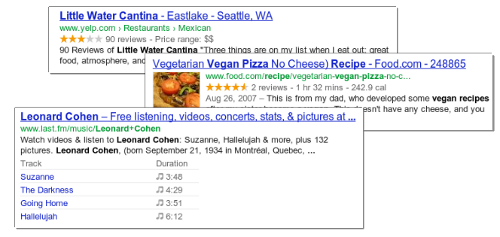
Traditional, text-only, search result snippets aim to summarize the content of a page in our search results. Rich snippets (shown above) allow webmasters to help us provide even better summaries using structured data markup that they can add to their pages. Today we're introducing a set of guidelines to help you implement high quality structured data markup for rich snippets.
Once you've correctly added structured data markup to you site, rich snippets are generated algorithmically based on that markup. If the markup on a page offers an accurate description of the page's content, is up-to-date, and is visible and easily discoverable on your page and by users, our algorithms are more likely to decide to show a rich snippet in Google’s search results.
Alternatively, if the rich snippets markup on a page is spammy, misleading, or otherwise abusive, our algorithms are much more likely to ignore the markup and render a text-only snippet. Keep in mind that, while rich snippets are generated algorithmically, we do reserve the right to take manual action (e.g., disable rich snippets for a specific site) in cases where we see actions that hurt the experience for our users.
To illustrate these guidelines with some examples:
- If your page is about a band, make sure you mark up concerts being performed by that band, not by related bands or bands in the same town.
- If you sell products through your site, make sure reviews on each page are about that page's product and not the store itself.
- If your site provides song lyrics, make sure reviews are about the quality of the lyrics, not the quality of the song itself.
Posted by Jeremy Lubin, Consumer Experience Specialist, & Pierre Far, Webmaster Trends Analyst
Selasa, 02 Oktober 2012
Google Webmaster Guidelines updated
Today we’re happy to announce an updated version of our Webmaster Quality Guidelines. Both our basic quality guidelines and many of our more specific articles (like those on links schemes or hidden text) have been reorganized and expanded to provide you with more information about how to create quality websites for both users and Google.
The main message of our quality guidelines hasn’t changed: Focus on the user. However, we’ve added more guidance and examples of behavior that you should avoid in order to keep your site in good standing with Google’s search results. We’ve also added a set of quality and technical guidelines for rich snippets, as structured markup is becoming increasingly popular.
We hope these updated guidelines will give you a better understanding of how to create and maintain Google-friendly websites.
Posted by Betty Huang & Eric Kuan, Google Search Quality Team
Senin, 01 Oktober 2012
Keeping you informed of critical website issues
Having a healthy and well-performing website is important, both to you as the webmaster and to your users. When we discover critical issues with a website, Webmaster Tools will now let you know by automatically sending an email with more information.
We’ll only notify you about issues that we think have significant impact on your site’s health or search performance and which have clear actions that you can take to address the issue. For example, we’ll email you if we detect malware on your site or see a significant increase in errors while crawling your site.
For most sites these kinds of issues will occur rarely. If your site does happen to have an issue, we cap the number of emails we send over a certain period of time to avoid flooding your inbox. If you don’t want to receive any email from Webmaster Tools you can change your email delivery preferences.
We hope that you find this change a useful way to stay up-to-date on critical and important issues regarding your site’s health. If you have any questions, please let us know via our Webmaster Help Forum.
Posted by John Mueller, Webmaster Trends Analyst, Google Zürich
Kamis, 20 September 2012
Structured Data Testing Tool
Today we’re excited to share the launch of a shiny new version of the rich snippet testing tool, now called the structured data testing tool. The major improvements are:
- We’ve improved how we display rich snippets in the testing tool to better match how they appear in search results.
- The brand new visual design makes it clearer what structured data we can extract from the page, and how that may be shown in our search results.
- The tool is now available in languages other than English to help webmasters from around the world build structured-data-enabled websites.
The new structured data testing tool works with all supported rich snippets and authorship markup, including applications, products, recipes, reviews, and others.
Try it yourself and, as always, if you have any questions or feedback, please tell us in the Webmaster Help Forum.
Written by Yong Zhu on behalf of the rich snippets testing tool team
Jumat, 14 September 2012
Answering the top questions from government webmasters
Government sites, from city to state to federal agencies, are extremely important to Google Search. For one thing, governments have a lot of content — and government websites are often the canonical source of information that’s important to citizens. Around 20 percent of Google searches are for local information, and local governments are experts in their communities.
That’s why I’ve spoken at the National Association of Government Webmasters (NAGW) national conference for the past few years. It’s always interesting speaking to webmasters about search, but the people running government websites have particular concerns and questions. Since some questions come up frequently I thought I’d share this FAQ for government websites.
Question 1: How do I fix an incorrect phone number or address in search results or Google Maps?
Although managing their agency’s site is plenty of work, government webmasters are often called upon to fix problems found elsewhere on the web too. By far the most common question I’ve taken is about fixing addresses and phone numbers in search results. In this case, government site owners really can do it themselves, by claiming their Google+ Local listing. Incorrect or missing phone numbers, addresses, and other information can be fixed by claiming the listing.
Most locations in Google Maps have a Google+ Local listing — businesses, offices, parks, landmarks, etc. I like to use the San Francisco Main Library as an example: it has contact info, detailed information like the hours they’re open, user reviews and fun extras like photos. When we think users are searching for libraries in San Francisco, we may display a map and a listing so they can find the library as quickly as possible.
If you work for a government agency and want to claim a listing, we recommend using a shared Google Account with an email address at your .gov domain if possible. Usually, ownership of the page is confirmed via a phone call or post card.
Question 2: I’ve claimed the listing for our office, but I have 43 different city parks to claim in Google Maps, and none of them have phones or mailboxes. How do I claim them?
Use the bulk uploader! If you have 10 or more listings / addresses to claim at the same time, you can upload a specially-formatted spreadsheet. Go to www.google.com/places/, click the "Get started now" button, and then look for the "bulk upload" link.
If you run into any issues, use the Verification Troubleshooter.
Question 3: We're moving from a .gov domain to a new .com domain. How should we move the site?
We have a Help Center article with more details, but the basic process involves the following steps:
- Make sure you have both the old and new domain verified in the same Webmaster Tools account.
- Use a 301 redirect on all pages to tell search engines your site has moved permanently.
- Don't do a single redirect from all pages to your new home page — this gives a bad user experience.
- If there's no 1:1 match between pages on your old site and your new site (recommended), try to redirect to a new page with similar content.
- If you can't do redirects, consider cross-domain canonical links.
- Make sure to check if the new location is crawlable by Googlebot using the Fetch as Google feature in Webmaster Tools.
- Use the Change of Address tool in Webmaster Tools to notify Google of your site's move.
- Have a look at the Links to Your Site in Webmaster Tools and inform the important sites that link to your content about your new location.
- We recommend not implementing other major changes at the same time, like large-scale content, URL structure, or navigational updates.
- To help Google pick up new URLs faster, use the Fetch as Google tool to ask Google to crawl your new site, and submit a Sitemap listing the URLs on your new site.
- To prevent confusion, it's best to retain control of your old site’s domain and keep redirects in place for as long as possible — at least 180 days.
In that case, many of the same steps apply: verify both sites in Webmaster Tools, use 301 redirects, clean up old links, etc. In this case you don't need to use the Change of Address form in Webmaster Tools since only part of your site is moving. If for some reason you’ll have some of the same content on both sites, you may want to include a cross-domain canonical link pointing to the preferred domain.
Question 4: We've done a ton of work to create unique titles and descriptions for pages. How do we get Google to pick them up?
First off, that's great! Better titles and descriptions help users decide to click through to get the information they need on your page. The government webmasters I’ve spoken with care a lot about the content and organization of their sites, and work hard to provide informative text for users.
Google's generation of page titles and descriptions (or "snippets") is completely automated and takes into account both the content of a page as well as references to it that appear on the web. Changes are picked up as we recrawl your site. But you can do two things to let us know about URLs that have changed:
- Submit an updated XML Sitemap so we know about all of the pages on your site.
- In Webmaster Tools, use the Fetch as Google feature on a URL you’ve updated. Then you can choose to submit it to the index.
- You can choose to submit all of the linked pages as well — if you’ve updated an entire section of your site, you might want to submit the main page or an index page for that section to let us know about a broad collection of URLs.
Question 5: How do I get into the YouTube government partner program?
For this question, I have bad news, good news, and then even better news. On the one hand, the government partner program has been discontinued. But don’t worry, because most of the features of the program are now available to your regular YouTube account. For example, you can now upload videos longer than 10 minutes.
Did I say I had even better news? YouTube has added a lot of functionality useful for governments in the past year:
- You can now broadcast live streaming video to YouTube via Hangouts On Air (requires a Google+ account).
- You can link your YouTube account with your Webmaster Tools account, making it the "official channel" for your site.
- Automatic captions continue to get better and better, supporting more languages.
Posted by Jason Morrison, Search Quality Team
Selasa, 31 Juli 2012
Introducing the Structured Data Dashboard
Structured data is becoming an increasingly important part of the web ecosystem. Google makes use of structured data in a number of ways including rich snippets which allow websites to highlight specific types of content in search results. Websites participate by marking up their content using industry-standard formats and schemas.
To provide webmasters with greater visibility into the structured data that Google knows about for their website, we’re introducing today a new feature in Webmaster Tools - the Structured Data Dashboard. The Structured Data Dashboard has three views: site, item type and page-level.
Site-level view
At the top level, the Structured Data Dashboard, which is under Optimization, aggregates this data (by root item type and vocabulary schema). Root item type means an item that is not an attribute of another on the same page. For example, the site below has about 2 million Schema.Org annotations for Books (“http://schema.org/Book”)
Itemtype-level view
It also provides per-page details for each item type, as seen below:
Google parses and stores a fixed number of pages for each site and item type. They are stored in decreasing order by the time in which they were crawled. We also keep all their structured data markup. For certain item types we also provide specialized preview columns as seen in this example below (e.g. “Name” is specific to schema.org Product).
The default sort order is such that it would facilitate inspection of the most recently added Structured Data.
Page-level view
Last but not least, we have a details page showing all attributes of every item type on the given page (as well as a link to the Rich Snippet testing tool for the page in question).
Webmasters can use the Structured Data Dashboard to verify that Google is picking up new markup, as well as to detect problems with existing markup, for example monitor potential changes in instance counts during site redesigns.
Posted by Thomas Biggs & Andrei Pascovici, Webmaster Tools Team
Kamis, 12 Juli 2012
New Crawl Error alerts from Webmaster Tools
Today we’re rolling out Crawl Error alerts to help keep you informed of the state of your site.
Since Googlebot regularly visits your site, we know when your site exhibits connectivity issues or suddenly spikes in pages returning HTTP error response codes (e.g. 404 File Not Found, 403 Forbidden, 503 Service Unavailable, etc). If your site is timing out or is exhibiting systemic errors when accessed by Googlebot, other visitors to your site might be having the same problem!
When we see such errors, we may send alerts –- in the form of messages in the Webmaster Tools Message Center –- to let you know what we’ve detected. Hopefully, given this increased communication, you can fix potential issues that may otherwise impact your site’s visitors or your site’s presence in search.
As we discussed in our blog post announcing the new Webmaster Tools Crawl Errors feature, we divide crawl errors into two types: Site Errors and URL Errors.
Site Error alerts for major site-wide problems
Site Errors represent an inability to connect to your site, and represent systemic issues rather than problems with specific pages. Here are some issues that might cause Site Errors:- Your DNS server is down or misconfigured.
- Your web server itself is firewalled off.
- Your web server is refusing connections from Googlebot.
- Your web server is overloaded, or down.
- Your site’s robots.txt is inaccessible.
![]() |
| Example of a Site Error alert |
If your site shows a 100% error rate in one of these categories, it likely means that your site is either down or misconfigured in some way. If your site has an error rate less than 100% in any of these categories, it could just indicate a transient condition, but it could also mean that your site is overloaded or improperly configured. You may want to investigate these issues further, or ask about them on our forum.
We may alert you even if the overall error rate is very low — in our experience a well configured site shouldn’t have any errors in these categories.
URL Error anomaly alerts for potentially less critical issues
Whereas any appreciable number of Site Errors could indicate that your site is misconfigured, overloaded, or simply out of service, URL Errors (pages that return a non-200 HTTP code, or incorrectly return an HTTP 200 code in the case of soft 404 errors) may occur on any well-configured site. Because different sites have different numbers of pages and different numbers of external links, a count of errors that indicates a serious problem for a small site might be entirely normal for a large site.That’s why for URL Errors we only send alerts when we detect a large spike in the number of errors for any of the five categories of errors (Server error, Soft 404, Access denied, Not found or Not followed). For example, if your site routinely has 100 pages with 404 errors, we won’t alert you if that number fluctuates minimally. However we might notify you when that count reaches a much higher number, say 500 or 1,000. Keep in mind that seeing 404 errors is not always bad, and can be a natural part of a healthy website (see our previous blog post: Do 404s hurt my site?).
A large spike in error count could be because something has changed on your site — perhaps a reconfiguration has changed the permissions for a section of your site, or a new version of a script is crashing regularly, or someone accidentally moved or deleted an entire directory, or a reorganization of your site causes external links to no longer work. It could also just be a transient spike, or could be because of external causes (someone has linked to non-existent pages), so there might not even be a problem; but when we see an unusually large number of errors for your site, we’ll let you know so you can investigate:
![]() |
| Example of a URL Error anomaly alert |
Enable Message forwarding to send alerts to your inbox
We know you’re busy, and that routinely checking Webmaster Tools just to check for new alerts might be something you forget to do. Consider turning on Message forwarding. We’ll send any Webmaster Tools messages to the email address of your choice.Let us know what you think, and if you have any comments or suggestions on our new alerts please visit our forum.
Written by Brian Malcolm, Webmaster Tools team
Kamis, 28 Juni 2012
Adding associates to manage your YouTube presence
Many organizations have multiple presences on the web. For example, Webmaster Tools lives at www.google.com/webmasters, but it also has a Twitter account and a YouTube channel. It's important that visitors to these other properties have confidence that they are actually associated with the Webmaster Tools site. However to date it has been challenging for webmasters to manage which users can take actions on behalf of their site in different services.
Today we're happy to announce a new feature in Webmaster Tools that allows webmasters to add "associates" -- trusted users who can act on behalf of your site in other Google products. Unlike site owners and users, associates can't view site data or take any site actions in Webmaster Tools, but they are authorized to perform specific tasks in other products.
For this initial launch, members of YouTube's partner program that have created a YouTube channel for their site can now link the two together. By doing this, your YouTube channel will be displayed as the "official channel" for your website.
Management within Webmaster Tools
To add or change associates:
- On the Webmaster Tools home page, click the site you want.
- Under Configuration, click Associates.
- Click Add a new associate.
- In the text box, type the email address of the person you want to add.
- Select the type of association you want.
- Click Add.
Management within YouTube
It’s also possible for users to request association from a site’s webmaster.- Log in to your YouTube partner account.
- Click on the user menu and choose Settings > Associated Website.
- Fill in the page you would like to associate your channel with.
- Click Add. If you’re a verified owner of the site, you’re done. But if someone else in your organization manages the website, the association will be marked Pending. The owner receives a notification with an option to approve or deny the request.
- After approval is granted, navigate back to this page and click Refresh to complete the association.
If you have more questions, please see the Help with Associates article or visit our webmaster help forum.
Posted by Konstantin Roslyakov, Software Engineer
Selasa, 26 Juni 2012
SEO essentials for startups in under 10 minutes
Wondering how to be search-friendly but lacking time for SEO research? We’d like to help! Meta keywords tag? Google Search ignores it. Meta description? Good to include.
If you:
- Work on a company website that’s under 50ish pages.
- Hope to rank well for your company name and a handful of related terms (not lots of terms like a news agency or e-commerce site).
- Want to be smart about search engines and attracting searchers, but haven’t kept up with the latest search news.
Everything I’d tell a startup if I had ten minutes as their SEO consultant.
More tips at developers.google.com/startups. Best of luck!
Written by Maile Ohye, Developer Programs Tech Lead
Selasa, 12 Juni 2012
For webmasters: Google+ and the +1 button 101
Here’s a video that covers the basics of Google+, the +1 button, getting started on Google+, and how social information can make products, like Search, more relevant. This video is for a range of webmasters (from personal bloggers to SEOs of corporations). So, if you’re interested in learning about Google+, we hope that with 20 minutes and this video on YouTube (we have our own Webmaster Support Channel!), you can feel more up to speed with Google’s social opportunities.
Video about the basics of Google+ and how to get started if you're an interested webmaster.
Speaking of Google+, if you join, please say hello! We're often posting and hosting Hangouts.
Written by Maile Ohye, Developer Programs Tech Lead
Rabu, 06 Juni 2012
Recommendations for building smartphone-optimized websites
Webmaster level: All
Every day more and more smartphones get activated and more websites are producing smartphone-optimized content. Since we last talked about how to build mobile-friendly websites, we’ve been working hard on improving Google’s support for smartphone-optimized content. As part of this effort, we launched Googlebot-Mobile for smartphones back in December 2011, which is specifically tasked with identifying such content.
Today we’d like to give you Google’s recommendations for building smartphone-optimized websites and explain how to do so in a way that gives both your desktop- and smartphone-optimized sites the best chance of performing well in Google’s search results.
Recommendations for smartphone-optimized sites
The full details of our recommendation can be found in our new help site, which we now summarize.
When building a website that targets smartphones, Google supports three different configurations:
Sites that use responsive web design, i.e. sites that serve all devices on the same set of URLs, with each URL serving the same HTML to all devices and using just CSS to change how the page is rendered on the device. This is Google’s recommended configuration.
Sites that dynamically serve all devices on the same set of URLs, but each URL serves different HTML (and CSS) depending on whether the user agent is a desktop or a mobile device.
Sites that have a separate mobile and desktop sites.
Responsive web design
Responsive web design is a technique to build web pages that alter how they look using CSS3 media queries. That is, there is one HTML code for the page regardless of the device accessing it, but its presentation changes using CSS media queries to specify which CSS rules apply for the browser displaying the page. You can learn more about responsive web design from this blog post by Google's webmasters and in our recommendations.
Using responsive web design has multiple advantages, including:
It keeps your desktop and mobile content on a single URL, which is easier for your users to interact with, share, and link to and for Google’s algorithms to assign the indexing properties to your content.
Google can discover your content more efficiently as we wouldn't need to crawl a page with the different Googlebot user agents to retrieve and index all the content.
Device-specific HTML
However, we appreciate that for many situations it may not be possible or appropriate to use responsive web design. That’s why we support having websites serve equivalent content using different, device-specific, HTML. The device-specific HTML can be served on the same URL (a configuration called dynamic serving) or different URLs (such as www.example.com and m.example.com).
If your website uses a dynamic serving configuration, we strongly recommend using the Vary HTTP header to communicate to caching servers and our algorithms that the content may change for different user agents requesting the page. We also use this as a crawling signal for Googlebot-Mobile. More details are here.
As for the separate mobile site configuration, since there are many ways to do this, our recommendation introduces annotations that communicate to our algorithms that your desktop and mobile pages are equivalent in purpose; that is, the new annotations describe the relationship between the desktop and mobile content as alternatives of each other and should be treated as a single entity with each alternative targeting a specific class of device.
These annotations will help us discover your smartphone-optimized content and help our algorithms understand the structure of your content, giving it the best chance of performing well in our search results.
Conclusion
This blog post is only a brief summary of our recommendation for building smartphone-optimized websites. Please read the full recommendation and see which supported implementation is most suitable for your site and users. And, as always, please ask on our Webmaster Help forums if you have more questions.
Posted by Pierre Far, Webmaster Trends Analyst
Senin, 04 Juni 2012
Easier domain verification
Today we’re announcing a new initiative that makes it easier for users to verify domains for Google services like Webmaster Tools and Google Apps.
First, some background on this initiative. To use certain Google services with your website or domain, you currently have to verify that you own the site or domain, since these services can share sensitive data (like search queries) or operate Internet-facing services (like hosted email) on your behalf.
One of our supported verification methods is domain verification. Currently this method requires a user to manually create a DNS TXT record to prove their ownership. For many users, this can be challenging and difficult to do.
So now, in collaboration with Go Daddy and eNom, we’re introducing a simple, automated solution for domain verification that guides you through the process in a few easy steps.
If your domain name records are managed by eNom or Go Daddy, in the Google site verification interface you will see a new, easier verification method as shown below.
Selecting this method launches a pop-up window that asks you to log in to the provider using your existing account with them.
The first time you log in, you’ll be asked to authorize the provider to access the Google site verification service on your behalf.
Next you’ll be asked to confirm that you wish to verify the domain.
And that’s it! After a few seconds, your domain should be automatically verified and a confirmation message displayed.
Now eNom and Go Daddy customers can more quickly and easily verify their domains to use with Google services like Webmaster Tools and Google Apps.
We’re also happy to share that Bluehost customers will be able to enjoy the same capability in the near future. And we look forward to working with more partners to bring easier domain verification to even more users. (Interested parties can contact us via this form.)
If you have any questions or feedback, as always please let us know via our webmaster help forum.
Posted by Anthony Chavez, Product Manager
Rabu, 30 Mei 2012
Now you can polish up Google’s translation of your website
Webmaster level: All
(Cross-posted on the Google Translate Blog)
Since we first launched the Website Translator plugin back in September 2009, more than a million websites have added the plugin. While we’ve kept improving our machine translation system since then, we may not reach perfection until someone invents full-blown Artificial Intelligence. In other words, you’ll still sometimes run into translations we didn’t get quite right.
So today, we’re launching a new experimental feature (in beta) that lets you customize and improve the way the Website Translator translates your site. Once you add the customization meta tag to a webpage, visitors will see your customized translations whenever they translate the page, even when they use the translation feature in Chrome and Google Toolbar. They’ll also now be able to ‘suggest a better translation’ when they notice a translation that’s not quite right, and later you can accept and use that suggestion on your site.
To get started:
- Add the Website Translator plugin and customization meta tag to your website
- Then translate a page into one of 60+ languages using the Website Translator
- Hover over a translated sentence to display the original text
- Click on ‘Contribute a better translation’
- And finally, click on a phrase to choose an automatic alternative translation -- or just double-click to edit the translation directly.
If you’re signed in, the corrections made on your site will go live right away -- the next time a visitor translates a page on your website, they’ll see your correction. If one of your visitors contributes a better translation, the suggestion will wait until you approve it. You can also invite other editors to make corrections and add translation glossary entries. You can learn more about these new features in the Help Center.
This new experimental feature is currently free of charge. We hope this feature, along with Translator Toolkit and the Translate API, can provide a low cost way to expand your reach globally and help to break down language barriers.
Posted by Jeff Chin, Product Manager, Google Translate