Jumat, 04 Desember 2009

Your site's performance in Webmaster Tools

Webmaster level: Intermediate

Let's take a quick look at the individual sections in the Google Webmaster Tools' Site Performance feature:

Performance overview


The performance overview shows a graph of the aggregated speed numbers for the website, based on the pages that were most frequently accessed by visitors who use the Google Toolbar with the PageRank feature activated. By using data from Google Toolbar users, you don't have to worry about us testing your site from a location that your users do not use. For example, if your site is in Germany and all your users are in Germany, the chart will reflect the load time as seen in Germany. Similarly, if your users mostly use dial-up connections (or high-speed broadband), that would be reflected in these numbers as well. If only a few visitors of your site use the Google Toolbar, we may not be able to show this data in Webmaster Tools.

The line between the red and the green sections on the chart is the 20th percentile — only 20% of the sites we check are faster than this. This website is pretty close to the 20% mark, which pages would we have to work on first?

Example pages with load times


In this section you can find some example pages along with the average, aggregated load times that users observed while they were on your website. These numbers may differ from what you see as they can come from a variety of different browsers, internet connections and locations. This list can help you to recognize pages which take longer than average to load — pages that slow your users down.

As the page load times are based on actual accesses made by your users, it's possible that it includes pages which are disallowed from crawling. While Googlebot will not be able to crawl disallowed pages, they may be a significant part of your site's user experience.

Keep in mind that you may see occasional spikes here, so it's recommended that you watch the load times over a short period to see what's stable. If you consistently see very large load times, that probably means that most of your users are seeing very slow page loads (whether due to slow connections or otherwise), so it's something you should take seriously.

Page Speed suggestions


These suggestions are based on the Page Speed Firefox / Firebug plugin. In order to find the details for these sample URLs, we fetch the page and all its embedded resources with Googlebot. If we are not able to fetch all of embedded content with Googlebot, we may not be able to provide a complete analysis. Similarly, if the servers return slightly modified content for Googlebot than they would for normal users, this may affect what is shown here. For example, some servers return uncompressed content for Googlebot, similar to what would be served to older browsers that do not support gzip-compressed embedded content (this is currently the case for Google Analytics' "ga.js").

When looking at flagged issues regarding common third-party code such as website analytics scripts, one factor that can also play a role is how wide-spread these scripts are on the web. If they are common across the web, chances are that the average user's browser will have already cached the DNS lookup and the content of the script. While these scripts will still be flagged as separate DNS lookups, in practice they might not play a strong role in the actual load time.

We offer these suggestions as a useful guideline regarding possible first performance improvement steps and recommend using the Page Speed plugin (or a similar tool) directly when working on your website. This allows you to better recognize the blocking issues and makes it easy to see how modifications on the server affect the total load time.


For questions about Webmaster Tools and this new feature, feel free to read the Help Center article, search and post in the Webmaster Help Forums or in the Page Speed discussion group. We hope this information helps you make your website even faster!

Rabu, 02 Desember 2009

How fast is your site?

We've just launched Site Performance, an experimental feature in Webmaster Tools that shows you information about the speed of your site and suggestions for making it faster.

This is a small step in our larger effort to make the web faster. Studies have repeatedly shown that speeding up your site leads to increased user retention and activity, higher revenue and lower costs. Towards the goal of making every webpage load as fast as flipping the pages of a magazine, we have provided articles on best practices, active discussion forums and many tools to diagnose and fix speed issues.

Now we bring data and statistics specifically applicable to your site. On Site Performance, you'll find how fast your pages load, how they've fared over time, how your site's load time compares to that of other sites, examples of specific pages and their actual page load times, and Page Speed suggestions that can help reduce user-perceived latency. Our goal is to bring you specific and actionable speed information backed by data, so stay tuned for more of this in the future.

screenshot of Site Performance

The load time data is derived from aggregated information sent by users of your site who have installed the Google Toolbar and opted-in to its enhanced features. We only show the performance charts and tables when there's enough data, so not all of them may be shown if your site has little traffic. The data currently represents a global average; a specific user may experience your site faster or slower than the average depending on their location and network conditions.

This is a Labs product that is still in development. We hope you find it useful. Please let us know your feedback through the Webmaster Tools Forum.

Update on 12/04/2009: Our team just reconvened to provide you more information on this feature. Check out JohnMu's latest post on Site Performance!

New User Agent for News

Webmaster Level: Intermediate

Today we are announcing a new user agent for robots.txt called Googlebot-News that gives publishers even more control over their content. In case you haven't heard of robots.txt, it's a web-wide standard that has been in use since 1994 and which has support from all major search engines and well-behaved "robots" that process the web. When a search engine checks whether it has permission to crawl and index a web page, the "check if we're allowed to crawl this page" mechanism is robots.txt.

Publishers could easily contact us via a form if they didn't want to be included in Google News but did want to be in Google's web search index. Now, publishers can manage their content in Google News in an even more automated way. Site owners can just add Googlebot-News specific directives to their robots.txt file. Similar to the Googlebot and Googlebot-Image user agents, the new Googlebot-News user agent can be used to specify which pages of a website should be crawled and ultimately appear in Google News.

Here are a few examples for publishers:

Include pages in both Google web search and News:
User-agent: Googlebot
Disallow:

This is the easiest case. In fact, a robots.txt file is not even required for this case.

Include pages in Google web search, but not in News:
User-agent: Googlebot
Disallow:

User-agent: Googlebot-News
Disallow: /

This robots.txt file says that no files are disallowed from Google's general web crawler, called Googlebot, but the user agent "Googlebot-News" is blocked from all files on the website.

Include pages in Google News, but not Google web search:
User-agent: Googlebot
Disallow: /

User-agent: Googlebot-News
Disallow:

When parsing a robots.txt file, Google obeys the most specific directive. The first two lines tell us that Googlebot (the user agent for Google's web index) is blocked from crawling any pages from the site. The next directive, which applies to the more specific user agent for Google News, overrides the blocking of Googlebot and gives permission for Google News to crawl pages from the website.

Block different sets of pages from Google web search and Google News:
User-agent: Googlebot
Disallow: /latest_news

User-agent: Googlebot-News
Disallow: /archives

The pages blocked from Google web search and Google News can be controlled independently. This robots.txt file blocks recent news articles (URLs in the /latest_news folder) from Google web search, but allows them to appear on Google News. Conversely, it blocks premium content (URLs in the /archives folder) from Google News, but allows them to appear in Google web search.

Stop Google web search and Google News from crawling pages:
User-agent: Googlebot
Disallow: /

This robots.txt file tells Google that Googlebot, the user agent for our web search crawler, should not crawl any pages from the site. Because no specific directive for Googlebot-News is given, our News search will abide by the general guidance for Googlebot and will not crawl pages for Google News.

For some queries, we display results from Google News in a discrete box or section on the web search results page, along with our regular web search results. We sometimes do this for Images, Videos, Maps, and Products, too. This is known as Universal search results. Since Google News powers Universal "News" search results, if you block the Googlebot-News user agent then your site's news stories won't be included in Universal search results.

We are currently testing our support for the new user agent. If you see any problems please let us know. Note that it is possible for Google to return a link to a page in some situations even when we didn't crawl that page. If you'd like to read more about robots.txt, we provide additional documentation on our website. We hope webmasters will enjoy the flexibility and easier management that the Googlebot-News user agent provides.

Selasa, 01 Desember 2009

Region Tags in Google Search Results

Webmaster Level: All

Country-code top-level domains (or ccTLDs) can provide people with a quick and valuable clue about the location of a website—for example, ".fr" for France or ".co.jp" for Japan. However, for certain top level domains like .com, .info and .org, it's not as easy to figure out the location. That's why today we're adding region information supplied by webmasters to the green address line on some Google search results.

This feature is easiest to explain through an example. Let's say you've heard about a boxing club in Canada called "Capital City Boxing." You try a search for [capital city boxing] to find out more, but it's hard to tell which result is the one you're looking for. Here's a screen shot:


None of the results provide any location information in the title or snippet, nor do they have a regional TLD (such as .ca for Canada). The only way to find the result you're looking for is to refine your search ([capital city boxing canada] works) or click through the various links to figure it out. Clicking through the first result reveals that there's apparently another "Capital City Boxing" club in Alabama.

Region tags improve search results by providing valuable information about website location right in the green URL line. Continuing our prior example, here's a screen shot of the new region tag (circled in red):


As you can see, the fourth result now includes the region name "Canada" after the green URL, so you can immediately tell that this result relates to the boxing club in Canada. With the new display, you no longer need to refine your search or click through the results to figure out which page is the one you're looking for. In general, our hope is that these region tags will help searchers more quickly identify which results are most relevant to their queries.

As a webmaster, you can control how this feature works by adjusting your Geographic Targeting settings. Log in to Webmaster Tools and choose Site configuration > Settings > Geographic Target. From here you can associate a particular country/region with your site. These settings will determine the name that appears as a region tag. You can learn more about using the Geographic Target tool in a prior blog post and in our Help Center.

We currently show region tags only for certain domains such as .com and .net where the location information would otherwise be unclear. We don't show region tags for results on domains like .br for Brazil, because the location is already implied by the green URL line in our default display. In addition, we only display region tags when the region supplied by the site owner is different from the domain where the search was entered. For example, if you do a search from the Singapore Google domain (google.com.sg), we won't show you region tags for all the websites webmasters have targeted to Singapore because we'd end up tagging too many results, and the tag is really most relevant for foreign regions. For the initial release, we anticipate roughly 1% of search results pages will include webpages with a region tag.

We hope you'll find this new feature useful, and we welcome your feedback.

Changes in First Click Free

Webmaster level: Intermediate

We love helping publishers make their content available to large groups of readers, and working on ways to make the world's information useful and accessible through our search results. At the same time, we're also aware of the fact that creating high-quality content is not easy and, in many cases, expensive. This is one of the reasons why we initially launched First Click Free for Google News and Google Web Search -- to allow publishers to sell access to their content in general while still allowing users to find it through our search results.

While we're happy to see that a number of publishers are already using First Click Free, we've found that some who might try it are worried about people abusing the spirit of First Click Free to access almost all of their content. As most users are generally happy to be able to access just a few pages from these premium content providers, we've decided to allow publishers to limit the number of accesses under the First Click Free policy to five free accesses per user each day. This change applies to both Google News publishers as well as websites indexed in Google's Web Search. We hope that this encourages even more publishers to open up more content to users around the world!

Questions and answers about First Click Free

Q: Do the rest of the old guidelines still apply?
A: Yes, please check the guidelines for Google News as well as the guidelines for Web Search and the associated blog post for more information.

Q: Can I apply First Click Free to only a section of my site / only for Google News (or only for Web Search)?
A: Sure! Just make sure that both Googlebot and users from the appropriate search results can view the content as required. Keep in mind that showing Googlebot the full content of a page while showing users a registration page would be considered cloaking.

Q: Do I have to sign up to use First Click Free?
A: Please let us know about your decision to use First Click Free if you are using it for Google News. There's no need to inform us of the First Click Free status for Google Web Search.

Q: What is the preferred way to count a user's accesses?
A: Since there are many different site architectures, we believe it's best to leave this up to the publisher to decide.

(Please see our related blog post for more information on First Click Free for Google News.)

Kamis, 26 November 2009

GENERIC CIALIS on my website? I think my site has been hacked!

How to use "Fetch as Googlebot", part 1
Webmaster level: Intermediate

Has your site ever dropped suddenly from the index or disappeared mysteriously from search results? Have you ever received a notice that your site is using cloaking techniques? Unfortunately, sometimes a malicious party "hacks" a website: they penetrate the security of a site and insert undesirable content. Sophisticated attackers can camouflage this spammy or dangerous content so that it doesn't appear for normal users, and appears only to Googlebot, which could negatively impact your site in Google's results.

In such cases it used to be very difficult to detect the problem, because the site would appear normal in the eyes of the user. It may be possible that only requests with a User-agent: of Googlebot and coming from Googlebot's IP could see the hidden content. But that's over: with Fetch as Googlebot, the new Labs feature in Webmaster Tools, you can see exactly what Googlebot is seeing, and avoid any kind of cloaking problems. We'll show you how:

Let's imagine that Bob, the administrator of www.example.com, is searching for his site but he finds this instead:


That's strange, because when he looks at the source code of www.example.com, it looks fine:


With much surprise Bob may receive a notice from Google warning him that his site is not complying with Google's quality guidelines. Fortunately he has his site registered with Webmaster Tools, let's see how he can check what Googlebot sees:

First Bob logs into Webmaster Tools and selects www.example.com. The Fetch as Googlebot feature will be at the bottom of the navigation menu, in the Labs section:


The page will contain a field where you can insert the URL to fetch. It can also be left blank to fetch the homepage.


Bob can simply click Fetch and wait a few seconds. After refreshing the page, he can see the status of the fetch request. If it succeeds, he can click on the "Success" link...


...and that will show the details, with the content of the fetched page:


Aha! There's the spammy content! Now Bob can be certain that www.example.com has been hacked.

Confirming that the website has been hacked (and perhaps is still hacked) is an important step. It is, however, only the beginning. For more information, we strongly suggest getting help from your server administrator or hoster and reading our previous blog posts on the subject of hacked sites:


If you have any questions about how to use the Fetch as Googlebot feature, feel free to drop by the Webmaster Help Forum. If you feel that your website might be hacked but are having problems resolving it, you might want to ask the experts in our "Malware and Hacked sites" category.

PS Keep in mind that once you have removed hacked content from your site, it will generally still take time for us to update our search results accordingly. There are a number of factors that affect crawling and indexing of your content so it's impossible to give a time-frame for that.

Rabu, 25 November 2009

Hard facts about comment spam

Webmaster Level: Beginner

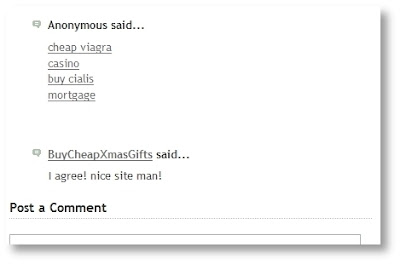
It has probably happened to you: you're reading articles or watching videos on the web, and you come across some unrelated, gibberish comments. You may wonder what this is all about. Some webmasters abuse other sites by exploiting their comment fields, posting tons of links that point back to the poster's site in an attempt to boost their site's ranking. Others might tweak this approach a bit by posting a generic comment (like "Nice site!") with a commercial user name linking to their site.

Why is it bad?

FACT: Abusing comment fields of innocent sites is a bad and risky way of getting links to your site. If you choose to do so, you are tarnishing other people's hard work and lowering the quality of the web, transforming a potentially good resource of additional information into a list of nonsense keywords.

FACT: Comment spammers are often trying to improve their site's organic search ranking by creating dubious inbound links to their site. Google has an understanding of the link graph of the web, and has algorithmic ways of discovering those alterations and tackling them. At best, a link spammer might spend hours doing spammy linkdrops which would count for little or nothing because Google is pretty good at devaluing these types of links. Think of all the more productive things one could do with that time and energy that would provide much more value for one's site in the long run.


Promote your site without comment spam

If you want to improve your site's visibility in the search results, spamming comments is definitely not the way to go. Instead, think about whether your site offers what people are looking for, such as useful information and tools.

FACT: Having original and useful content and making your site search engine friendly is the best strategy for better ranking. With an appealing site, you'll be recognized by the web community as a reliable source and links to your site will build naturally.

Moreover, Google provides a list of advice in order to improve the crawlability and indexability of your site. Check out our Search Engine Optimization Starter Guide.

What can I do to avoid spam on my site?

Comments can be a really good source of information and an efficient way of engaging a site's users in discussions. This valuable content should not be replaced by gibberish nonsense keywords and links. For this reason there are many ways of securing your application and disincentivizing spammers.
  • Disallow anonymous posting.
  • Use CAPTCHAs and other methods to prevent automated comment spamming.
  • Turn on comment moderation.
  • Use the "nofollow" attribute for links in the comment field.
  • Disallow hyperlinks in comments.
  • Block comment pages using robots.txt or meta tags.
For detailed information about these topics, check out our Help Center document on comment spam.

My site is full of comment spam, what should I do?

It's never too late! Don't let spammers ruin the experience for others. Adopt security measures discussed above to stop the spam activity, then invest some time to clean up the spammy comments and ban the spammers from your site. Depending on you site's system, you may be able to save time by banning spammers and removing their comments all at once, rather than one by one.

If I spammed comment fields of third party sites, what should I do?

If you used this approach in the past and you want to solve this issue, you should have a look at your incoming links in Webmaster Tools. To do so, go to the Your site on the web section and click on Links to your site. If you see suspicious links coming from blogs or other platforms allowing comments, you should check these URLs. If you see a spammy link you created, try to delete it, else contact the webmaster to ask to remove the link. Once you've cleared the spammy inbound links you made, you can file a reconsideration request.

For more information about this topic and to discuss it with others, join us in the Webmaster Help Forum. (But don't leave spammy comments!)